ComputerWorld

ComputerWorldIndependent

U.S. House approves new privacy protections for email and the cloud

The U.S. House of Representatives approved on Monday the Email Privacy Act, which would require law enforcement agencies to get court-ordered warrants to search email and other data stored with third parties for longer than six months. 

The House approved the bill by voice vote, and it now goes the Senate for consideration.

The Email Privacy Act would update a 31-year-old law called the Electronic Communications Privacy Act (ECPA). Some privacy advocates and tech companies have pushed Congress to update ECPA since 2011. Lax protections for stored data raise doubts about U.S. cloud services among consumers and enterprises, supporters of the bill say.

To read this article in full or to leave a comment, please click here

Read More
ComputerWorldIndependent

President Bannon Chrome Extension is a security problem, not a joke

Pretending that Steve Bannon is really the President was funny when Saturday Night Live did it on their opening bit. Then today, Business Insider wrote about a Google Chrome extension that replaces every mention of “Trump” with “Steve Bannon” on all web pages. Funny? Not from a Defensive Computing perspective.

Any extension that can change a specific word on every web page is inherently dangerous. Almost by definition, such an extension is spyware.

presidentbannon.permissions Michael Horowitz

Installing the President Bannon extension to the Chrome browser

To read this article in full or to leave a comment, please click here

Read More
ComputerWorldIndependent

Update: TV maker Vizio pays $2.2M to settle complaint that it spied on users

Popular smart TV maker Vizio will pay $2.2 million to settle complaints that it violated customers’ privacy by continuously monitoring their viewing habits without their knowledge.

Beginning in February 2014, the Irvine, California-based TV maker tracked what TV shows customers were watching on 11 million TV sets sold in the U.S., the Federal Trade Commission and the Office of the New Jersey Attorney General said in a complaint, released Monday.

Vizio smart TVs captured “second-by-second” information about video displayed, including video from consumer cable services, broadband, set-top boxes, DVDs, over-the-air broadcasts and streaming devices, according to the complaint.

To read this article in full or to leave a comment, please click here

Read More
ComputerWorldIndependent

Hacker takes out dark web hosting service using well-known exploit

A hacker is proving that sites on the dark web, shrouded in anonymity, can easily be compromised.   

On Friday, the unnamed hacker began dumping a sizable database stolen from Freedom Hosting II onto the internet, potentially exposing its users.

The hosting service, Freedom Hosting II, was known for operating thousands of sites that were accessible through the Tor browser; the “dark web” is essentially the encrypted network comprising Tor servers and browsers. But on Friday, the service appeared to be down. Its main landing page was replaced with a message saying that it had been hacked.

Allegedly, Freedom Hosting II had been hosting child pornography sites, though its anonymous operator claimed to have a zero-tolerance policy toward such content, according to the hacker behind the breach.

To read this article in full or to leave a comment, please click here

Read More
ComputerWorldIndependent

Malware distributors switch to less suspicious file types

After aggressively using JavaScript email attachments to distribute malware for the past year, attackers are now switching to less suspicious file types to trick users.

Last week, researchers from the Microsoft Malware Protection Center warned about a new wave of spam emails that carried malicious .LNK files inside ZIP archives. Those files had malicious PowerShell scripts attached to them.

PowerShell is a scripting language for automating Windows system administration tasks. It has been abused to download malware in the past and there are even malware programs written entirely in PowerShell.

To read this article in full or to leave a comment, please click here

Read More
ComputerWorldIndependent

TV maker Vizio pays $2.2M to settle complaint that it spied on users

Popular smart TV maker Vizio will pay $2.2 million to settle complaints that it violated customers’ privacy by continuously monitoring their viewing habits without their knowledge.

Beginning in February 2014, the Irvine, California-based TV maker tracked what TV shows customers were watching on 11 million TV sets sold in the U.S., the Federal Trade Commission and the Office of the New Jersey Attorney General said in a complaint, released Monday.

Vizio smart TVs captured “second-by-second” information about video displayed, including video from consumer cable services, broadband, set-top boxes, DVDs, over-the-air broadcasts and streaming devices, according to the complaint.

To read this article in full or to leave a comment, please click here

Read More
ComputerWorldIndependent

Researchers’ quantum hacking machine may help protect against quantum computing hacks

There seems to be no form of computing which is safe from hacking, but some, such as the Chinese, have pinned their hopes on quantum computing having uncrackable communications. Yet University of Ottawa researchers have managed to build “the first high-dimensional quantum cloning machine capable of performing quantum hacking to intercept a secure quantum message.”

Last year, China launched the world’s first known quantum communications satellite; the Chinese believed its Quantum Experiments at Space Scale (QUESS) satellite was a step toward “creating an unhackable communications system.” While it may seem like the Canadian researchers have poked holes in the dream of secure quantum communications, the opposite may actually be true.

To read this article in full or to leave a comment, please click here

Read More
ComputerWorldIndependent

Hacker hijacks thousands of publicly exposed printers to warn owners

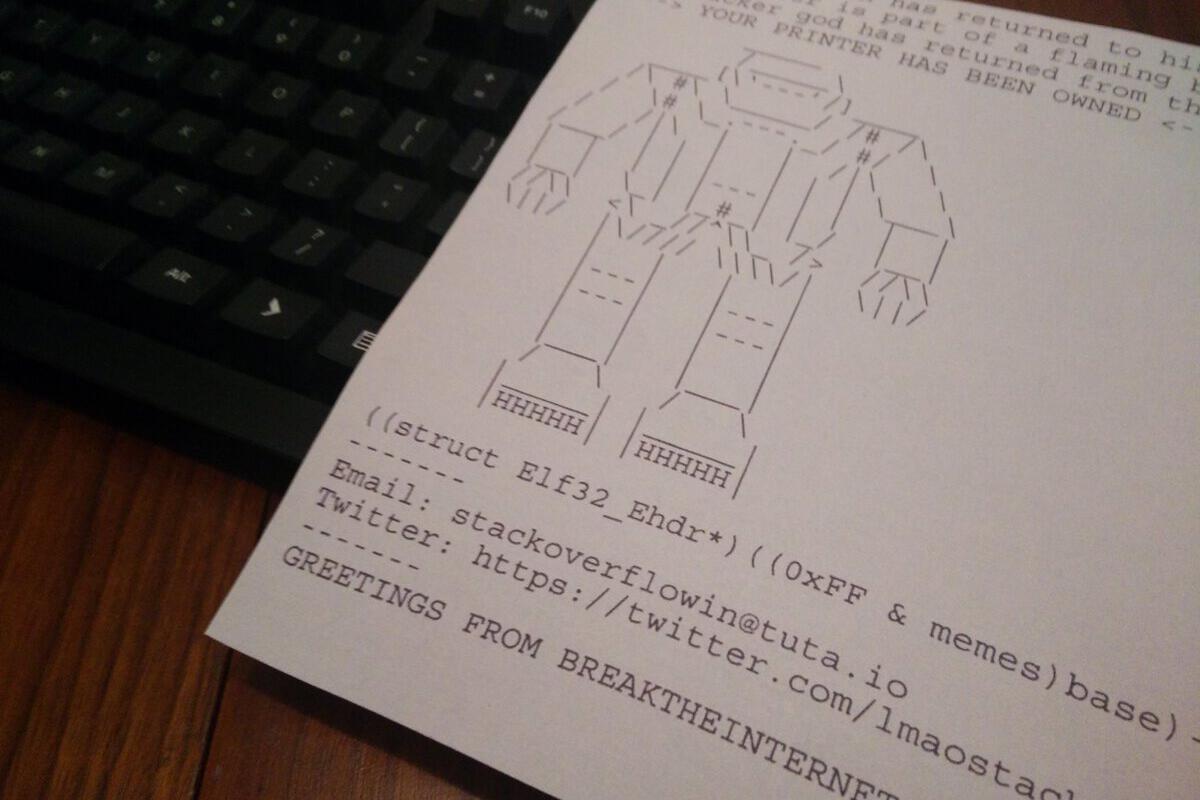
Following recent research that showed many printer models are vulnerable to attacks, a hacker decided to prove the point and forced thousands of publicly exposed printers to spew out rogue messages.

The messages included ASCII art depicting robots and warned that the printers had been compromised and they were part of a botnet. The hacker, who uses the online alias Stackoverflowin, later said that the botnet claim was not true and that his efforts served only to raise awareness about the risks of leaving printers exposed to the internet.

Stackoverflowin claims to be a high school student from the U.K. who is interested in security research. He said that for the most part he simply sent print jobs using the Line Printer Daemon (LPD), the Internet Printing Protocol (IPP) and the RAW protocol on communications port 9100 to printers that didn’t require authentication.

To read this article in full or to leave a comment, please click here

Read More