Independent

ComputerWorldIndependent

After WikiLeaks' CIA dump, China tells U.S. to stop spying

Credit to Author: Gregg Keizer| Date: Thu, 09 Mar 2017 10:37:00 -0800

China today asked the U.S. government to stop spying on it, China’s first reaction to WikiLeaks’ disclosure of a trove of CIA documents that alleged the agency was able to hack smartphones, personal computers, routers and other digital devices worldwide.

“We urge the U.S. to stop listening in, monitoring, stealing secrets and [conducting] cyber-attacks against China and other countries,” said Geng Shuang, a Foreign Ministry spokesman said today in a Beijing press briefing.

Geng also said that China would protect its own networks, was willing to work with others toward what he called “orderly cyberspace,” and repeated his government’s stock denunciation of hacking.

To read this article in full or to leave a comment, please click here

Read More
ComputerWorldIndependent

Assange: CIA had lost control of its cyberweapon documents

Credit to Author: Grant Gross| Date: Thu, 09 Mar 2017 08:53:00 -0800

Information about purported CIA cyberattacks was “passed around” among members of the U.S. intelligence community and contractors before it was published by WikiLeaks this week, Julian Assange says.

The CIA “lost control of its entire cyberweapons arsenal,” the WikiLeaks editor-in-chief said during a press conference Thursday. “This is a historic act of devastating incompetence, to have created such an arsenal and stored all in one place and not secured it.”

Assange declined to name the source who gave the information to WikiLeaks, but he seemed to suggest the 8,700-plus documents, purportedly from an isolated CIA server, came from an insider source.

To read this article in full or to leave a comment, please click here
Read More
ComputerWorldIndependent

Hackers exploit Apache Struts vulnerability to compromise corporate web servers

Credit to Author: Lucian Constantin| Date: Thu, 09 Mar 2017 04:19:00 -0800

Attackers are widely exploiting a recently patched vulnerability in Apache Struts that allows them to remotely execute malicious code on web servers.

Apache Struts is an open-source web development framework for Java web applications. It’s widely used to build corporate websites in sectors including education, government, financial services, retail and media.

On Monday, the Apache Struts developers fixed a high-impact vulnerability in the framework’s Jakarta Multipart parser. Hours later, an exploit for the flaw appeared on Chinese-language websites, which was almost immediately followed by real-world attacks, according to researchers from Cisco Systems.

To read this article in full or to leave a comment, please click here

Read More
ComputerWorldIndependent

Why email is safer in Office 365 than on your Exchange server

Credit to Author: Mary Branscombe| Date: Thu, 09 Mar 2017 04:11:00 -0800

Running your own email servers doesn’t do anything to differentiate your business from the competition (except in a bad way, if you get hacked). But avoiding the effort of managing and monitoring your own mail server isn’t the only advantage of a cloud service. The scale of a cloud mail provider like Office 365 means that malware and phishing attacks are easier to spot — and the protections extend beyond your inbox.

To read this article in full or to leave a comment, please click here

(Insider Story)

Read More
ComputerWorldIndependent

WikiLeaks looks at helping tech vendors disarm CIA hacking tools

Credit to Author: Michael Kan| Date: Thu, 09 Mar 2017 03:57:00 -0800

WikiLeaks has attracted plenty of haters over its controversial disclosures. But the site may be in a unique position to help tech vendors better secure their products.

That’s because WikiLeaks has published secret hacking tools allegedly taken from the CIA, which appear to target smartphones, smart TVs and PCs.

Companies including Apple and Cisco have been looking through the stolen documents to address any vulnerabilities the CIA may have exploited. However, WikiLeaks might be able to speed up and expand the whole process.

To read this article in full or to leave a comment, please click here

Read More
ComputerWorldIndependent

Security holes in Confide messaging app exposed user details

Credit to Author: Michael Kan| Date: Wed, 08 Mar 2017 12:51:00 -0800

Confide, a messaging app reportedly used by U.S. White House staff, apparently had several security holes that made it easier to hack.

Security consultancy IOActive found the vulnerabilities in Confide, which promotes itself as an app that offers “military-grade” end-to-end encryption.

But despite its marketing, the app contained glaring problems with securing user account information, IOActive said in a Wednesday post.

The consultancy noticed it could access records for 7,000 Confide users by exploiting vulnerabilities in the app’s account management system. Part of the problem resided with Confide’s API, which could be used to reveal data on user’s phone numbers and email addresses.

To read this article in full or to leave a comment, please click here

Read More
ComputerWorldIndependent

Leaked docs suggest NSA and CIA behind Equation cyberespionage group

Credit to Author: Lucian Constantin| Date: Wed, 08 Mar 2017 12:40:00 -0800

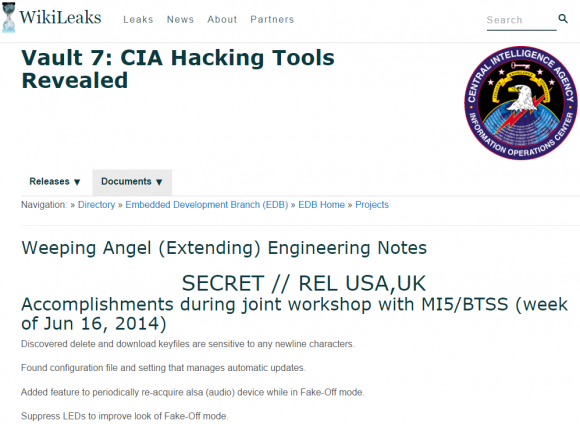
Purported CIA documents leaked Tuesday appear to confirm that the U.S. National Security Agency and one of the CIA’s own divisions were responsible for the malware tools and operations attributed to a group that security researchers have dubbed the Equation.

The Equation’s cyberespionage activities were documented in February 2015 by researchers from antivirus vendor Kaspersky Lab. It is widely considered to be the most advanced cyberespionage group in the world, based on the sophistication of its tools and the length of its operations, some possibly dating as far back as 1996.

To read this article in full or to leave a comment, please click here
Read More
IndependentKrebs

WikiLeaks Dumps Docs on CIA’s Hacking Tools

Credit to Author: BrianKrebs| Date: Wed, 08 Mar 2017 18:39:11 +0000

WikiLeaks on Tuesday dropped one of its most explosive word bombs ever: A secret trove of documents apparently stolen from the U.S. Central Intelligence Agency (CIA) detailing methods of hacking everything from smart phones and TVs to compromising Internet routers and computers. KrebsOnSecurity is still digesting much of this fascinating data cache, but here are some first impressions based on what I’ve seen so far.

Read More