Video game giant GameStop Corp. [NSYE: GME] says it is investigating reports that hackers may have siphoned credit card and customer data from its website — gamestop.com. The company acknowledged the investigation after being contacted by KrebsOnSecurity.
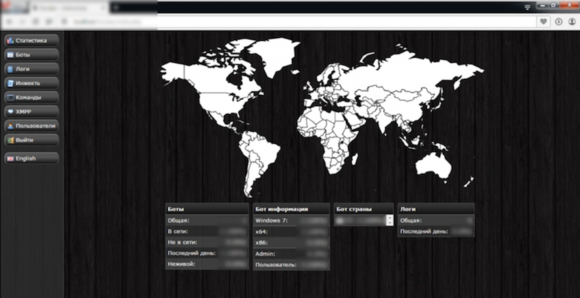
The author of a banking Trojan called Nuclear Bot — a teenager living in France — recently released the source code for his creation just months after the malware began showing up for sale in cybercrime forums. Now the young man’s father is trying to convince him not to act on a job offer in the United States, fearing it may be a trap set by law enforcement agents.
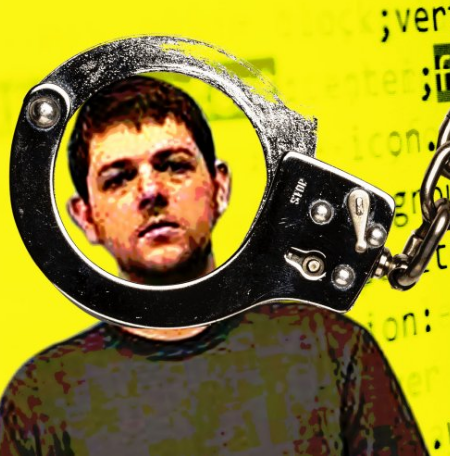
“He built a piece of software. That tool was pirated and abused by hackers. Now the feds want him to pay for the computer crooks’ crimes.” The above snippet is the subhead of a story published last month by the Daily Beast titled “FBI Arrests Hacker Who Hacked No One.” The subject of that piece — a 26-year-old American named Taylor Huddleston — faces felony hacking charges connected to two computer programs he authored and sold: An anti-piracy product called Net Seal, and a Remote Administration Tool (RAT) called NanoCore that he says was a benign program designed to help users remotely administer their computers. The author of the Daily Beast story, former black hat hacker and Wired.com editor Kevin Poulsen, argues that Huddelston’s case “raises a novel question: When is a programmer criminally responsible for the actions of his users? Some experts say [the case] could have far reaching implications for developers, particularly those working on new technologies that criminals might adopt in unforeseeable ways.” But a closer look at the government’s side of the story — as well as public postings left behind by the accused and his alleged accomplices — paints a more complex and nuanced picture that suggests this may not be the case to raise that legal question in a meaningful way.
Credit to Author: BrianKrebs| Date: Fri, 31 Mar 2017 16:33:24 +0000
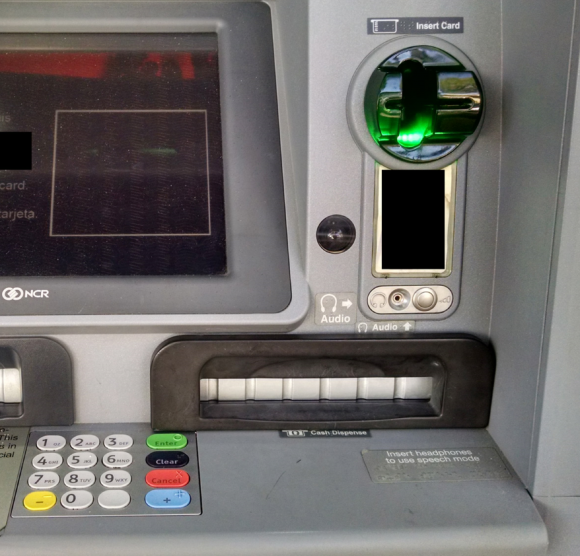
Once you understand how easy and common it is for thieves to attach “skimming” devices to ATMs and other machines that accept debit and credit cards, it’s difficult not to closely inspect and even tug on the machines before using them. Several readers who are in the habit of doing just that recently shared images of skimmers they discovered after gently pulling on various parts of a cash machine they were about to use.
Credit to Author: BrianKrebs| Date: Thu, 30 Mar 2017 21:33:48 +0000
Many readers are understandably concerned about recent moves by the U.S. Congress that would roll back privacy rules barring broadband Internet service providers (ISPs) from sharing or selling customer browsing history, among other personal data. Some are concerned enough by this development that they’re looking at obfuscating all of their online browsing by paying for a subscription to a virtual private networking (VPN) service. This piece is intended to serve as a guidepost for those contemplating such a move.
Credit to Author: BrianKrebs| Date: Mon, 27 Mar 2017 13:56:31 +0000
Police in Israel are recommending that the state attorney’s office indict and prosecute two 18-year-olds suspected of operating vDOS, until recently the most popular attack service for knocking Web sites offline. On Sept. 8, 2016, KrebsOnSecurity published a story about the hacking of vDOS, a service that attracted tens of thousands of paying customers and facilitated countless distributed denial-of-service (DDoS) attacks. That story named two young Israelis — Yarden Bidani and Itay Huri — as the likely owners and operators of vDOS, and within hours of its publication the two were arrested by Israeli police, placed on house arrest for 10 days, and forbidden from using the Internet for a month.
Credit to Author: BrianKrebs| Date: Fri, 24 Mar 2017 16:03:21 +0000
A recent, massive spike in sophisticated and successful phishing attacks is prompting many universities to speed up timetables for deploying mandatory two-factor authentication (2FA) — requiring a one-time code in addition to a password — for access to student and faculty services online. This is the story of one university that accelerated plans to require 2FA after witnessing nearly twice as many phishing victims in the first two-and-half months of this year than it saw in all of 2015.
Credit to Author: BrianKrebs| Date: Wed, 22 Mar 2017 17:59:44 +0000
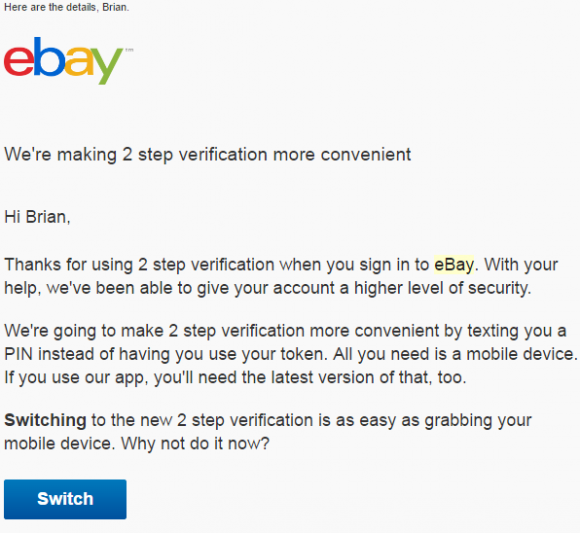
Last week, KrebsOnSecurity received an email from eBay. The company wanted me to switch from using a hardware key fob when logging into eBay to receiving a one-time code sent via text message. I found it remarkable that eBay, which at one time was well ahead of most e-commerce companies in providing more robust online authentication options, is now essentially trying to downgrade my login experience to a less-secure option.