Credit to Author: Gregg Keizer| Date: Fri, 12 May 2017 11:48:00 -0700
A Microsoft manager this week offered IT administrators a way to replicate — in a fashion — the security bulletins the company discarded last month.
“If you want a report summarizing today’s #MSRC security bulletins, here’s a script that uses the MSRC Portal API,” John Lambert, general manager of the Microsoft Threat Intelligence Center, said in a Tuesday message on Twitter.
Lambert’s tweet linked to code depository GitHub, where he posted a PowerShell script that polled data using a new API (application programming interface). Microsoft made the API available in November when it first announced that it planned to axe the security bulletins it had issued since at least 1998.
Credit to Author: Michael Kan| Date: Fri, 12 May 2017 10:27:00 -0700
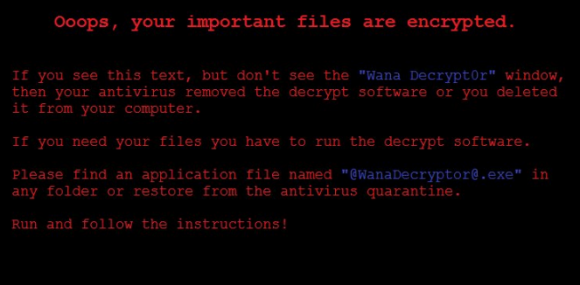
A ransomware attack appears to be spreading around the world, leveraging a hacking tool that may have come from the U.S. National Security Agency.
The ransomware, called Wanna Decryptor, struck hospitals at the U.K.’s National Health Service on Friday, taking down some of its network.
Spain’s computer response team, CCN-CERT, has also warned of a “massive attack” from the ransomware strain, amid reports that local telecommunications firm Telefonica was hit.
Credit to Author: Greg Lambert| Date: Fri, 12 May 2017 10:29:00 -0700
For this May Microsoft Patch Tuesday, we see Microsoft attempt to resolve 56 reported vulnerabilities in Microsoft Office, Windows, both Browsers and the .NET development platform.
Three of the vulnerabilities have been reported publicly and several have been actively exploited. Adding to an already serious situation, Microsoft’s anti-malware tool was compromised, resulting in the inadvertent deployment of malware through the anti-malware engine.
Microsoft responded very quickly with an out-of-band update (Security Advisory 4022344). Though there was general relief and kudos to Microsoft for their rapid response to this embarrassing episode, this bug was described as the “worst in recent memory” and as “crazy bad” by two of the lead researchers from Google’s Project Zero.
Credit to Author: Michael Kan| Date: Fri, 12 May 2017 10:27:00 -0700
A ransomware attack appears to be spreading around the world, leveraging a hacking tool that may have come from the U.S. National Security Agency.
The ransomware, called Wanna Decryptor, struck hospitals at the U.K.’s National Health Service on Friday, taking down some of its network.
Spain’s computer response team, CCN-CERT, has also warned of a “massive attack” from the ransomware strain, amid reports that local telecommunications firm Telefonica was hit.
Credit to Author: BrianKrebs| Date: Fri, 12 May 2017 16:54:01 +0000
At least 16 hospitals in the United Kingdom are being forced to divert emergency patients today after computer systems there were infected with ransomware, a type of malicious software that encrypts a victim’s documents, images, music and other files unless the victim pays for a key to unlock them. It remains unclear exactly how this ransomware strain is being disseminated and why it appears to have spread so quickly, but there are indications the malware may be spreading to vulnerable systems through a security hole in Windows that was recently patched by Microsoft.