internet

ComputerWorldIndependent

Defensive Computing for email attachments

Credit to Author: Michael Horowitz| Date: Wed, 15 Mar 2017 12:12:00 -0700

Email attachments remain an effective way to infect/compromise computers because people trust them too much. Blindly opening them is easy, simple and quick, but, it’s also not secure. What is secure?

Never open email attachments using Microsoft Office or Adobe’s PDF reading software.

Really should go without saying at this point.

Never open attachments on a Windows, Mac or Linux computer you care about or use regularly.

These old desktop systems are simply not as secure as more modern operating systems.

The safest computers for opening suspect files run iOS or Chrome OS.

To read this article in full or to leave a comment, please click here

Read More
ComputerWorldIndependent

4 charged, including Russian gov't agents, for massive Yahoo hack

Credit to Author: Martyn Williams| Date: Wed, 15 Mar 2017 09:22:00 -0700

The FBI on Wednesday charged four people, including two Russian state intelligence agents, for their involvement in a massive hack of Yahoo that affected half a billion accounts.

In September, Yahoo said hackers had managed to steal personal data on more than 500 million users during an attack in late 2014. The stolen data included names, email addresses, telephone numbers and hashed passwords. Blame for the attack was put on a “state-sponsored” group.

The FBI said that group was the Russian Federal Security Service, the FSB, and it identified agents Dmitry Dokuchaev and Igor Sushchin as leaders of the attack.

To read this article in full or to leave a comment, please click here
Read More
ComputerWorldIndependent

Twitter accounts hacked, Twitter Counter steps forward as culprit

Credit to Author: Peter Sayer| Date: Wed, 15 Mar 2017 07:37:00 -0700

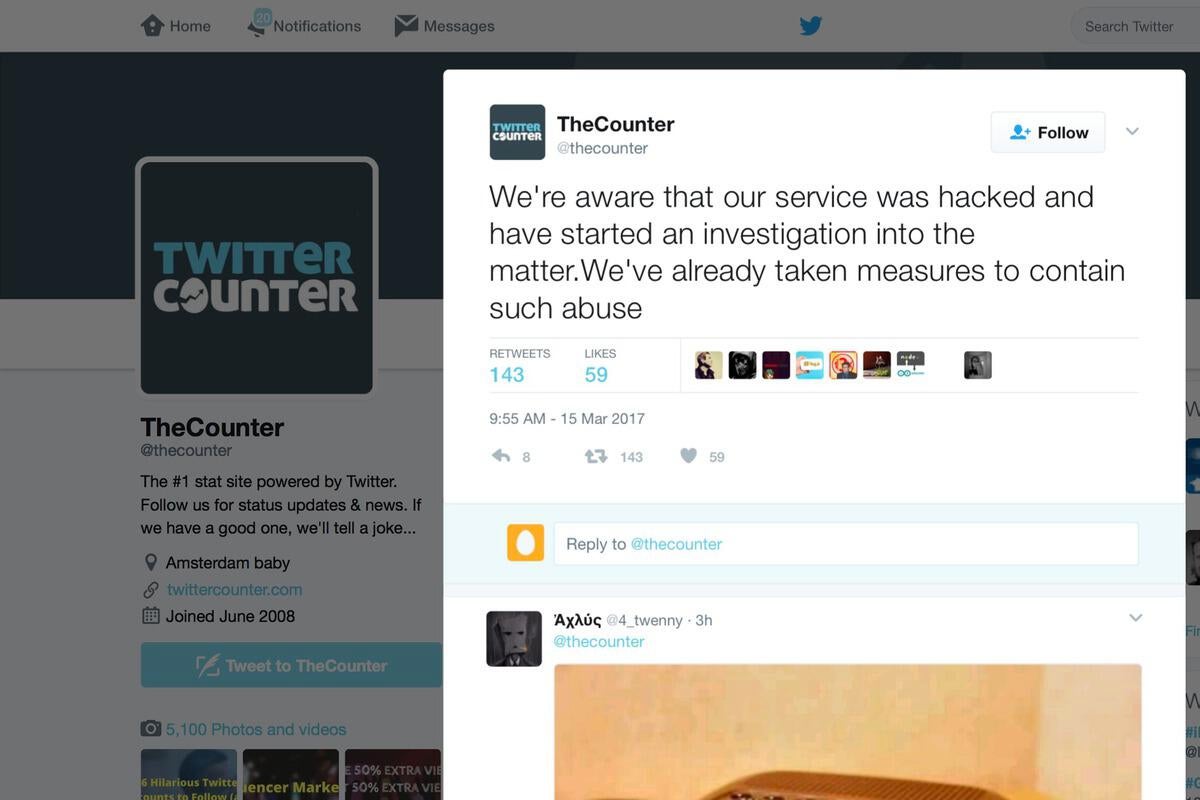
Twitter Counter, a third-party analytics service, appears once again to have provided a gateway for hackers to post messages to high-profile Twitter accounts.

An unlikely number of Twitter users suddenly learned to speak Turkish on Wednesday, posting an inflammatory message in the language replete with Nazi swastikas.

Among those posting the message were the Twitter accounts of Forbes magazine, the Atlanta Police Department, and Amnesty International, one of the few hacked accounts one might expect to actually speak Turkish.

Fears that these accounts had all been hacked were quickly allayed, when Twitter identified a third-party app as being to blame.

To read this article in full or to leave a comment, please click here
Read More
ComputerWorldIndependent

Twitter Counter hacked: Hundreds of high-profile Twitter accounts hijacked

Credit to Author: Darlene Storm| Date: Wed, 15 Mar 2017 06:16:00 -0700

Twitter seemed to temporarily be overtaken by tweets featuring swastikas, Turkish flags and Nazi references after third-party analytics app Twitter Counter was hacked.

It’s unclear how many Twitter accounts were affected – hundreds or thousands – considering Twitter Counter claims to have more than two million users who linked their Twitter accounts to its service for the purpose of providing statistics and tracking responses to tweets.

Infosec journalist Graham Cluley apologized “for the Nazi spam” after his account was hijacked. There was a rush of people scrubbing their accounts as Amnesty International, Duke University, Forbes, Reuters Japan, BBC North America, UNICEF USA, the UK Department of Health, the CEO of Sprint, bitcoin wallet Blockchain, the Atlanta Police Department, Starbucks Argentina, the European Parliament, Nike Spain, sports stars, celebrities and many others were compromised and also spewed Nazi spam.

To read this article in full or to leave a comment, please click here
Read More
ComputerWorldIndependent

The NSA's foreign surveillance: 5 things to know

Credit to Author: Grant Gross| Date: Tue, 14 Mar 2017 09:27:00 -0700

A contentious piece of U.S. law giving the National Security Agency broad authority to spy on people overseas expires at the end of the year. Expect heated debate about the scope of U.S. surveillance law leading up to Dec. 31.

One major issue to watch involves the way the surveillance treats communications from U.S. residents. Critics say U.S. emails, texts, and chat logs — potentially millions of them — are caught up in surveillance authorized by Section 702 of the Foreign Intelligence Surveillance Act (FISA).

U.S. residents who communicate with foreign targets of the NSA surveillance have their data swept up in what the NSA calls “incidental” collection. The FBI can then search those communications, but it’s unclear how often that happens.

To read this article in full or to leave a comment, please click here

Read More
ComputerWorldIndependent

A hard learned lesson in VPNs and secure websites

Credit to Author: Michael Horowitz| Date: Mon, 06 Mar 2017 17:00:00 -0800

Being a Defensive Computing kind of guy, I am a frequent flyer when it comes to VPN usage. But VPNs have both an upside and a downside.

Previously, I wrote about an unexpected downside that I ran into while making a purchase while logged into a VPN server in another country. I won’t be doing that again.

This time, a VPN interfered with a charitable donation.

I am a big fan of Libre Office. Yesterday, I tried to make a donation to the organization behind it, The Document Foundation, but my credit card was denied with a “transaction failed” error message.

To read this article in full or to leave a comment, please click here

Read More
ComputerWorldIndependent

FCC halts data security rules

Credit to Author: John Ribeiro| Date: Thu, 02 Mar 2017 03:59:00 -0800

The U.S. Federal Communications Commission has halted new rules that would require high-speed internet providers to take ‘reasonable’ steps to protect customer data.

In a 2-1 vote that went along party lines, the FCC voted Wednesday to stay temporarily one part of privacy rules passed in October that would give consumers the right to decide how their data is used and shared by broadband providers.

The rules include the requirement that internet service providers should obtain “opt-in” consent from consumers to use and share sensitive information such as geolocation and web browsing history, and also give customers the option to opt out from the sharing of non-sensitive information such as email addresses or service tier information.

To read this article in full or to leave a comment, please click here

Read More
ComputerWorldIndependent

Google shifts on email encryption tool, leaving its fate unclear

Credit to Author: Michael Kan| Date: Mon, 27 Feb 2017 13:34:00 -0800

Google is asking developers to take over its effort to make end-to-end email encryption more user-friendly, raising questions over whether it’ll ever become an official feature in the company’s browser.

On Friday, the search giant said its email encryption tool, originally announced in 2014, was no longer a Google product. Instead, it’s become a “full community-driven open source project,” the company said in a blog post.

The tool is designed to work as an extension to Google’s Chrome browser that uses the OpenPGP standard to encrypt emails, ensuring that only the recipient can read them, and not the email provider or a government.  

To read this article in full or to leave a comment, please click here

Read More