How to set up Azure AD to spot risky users
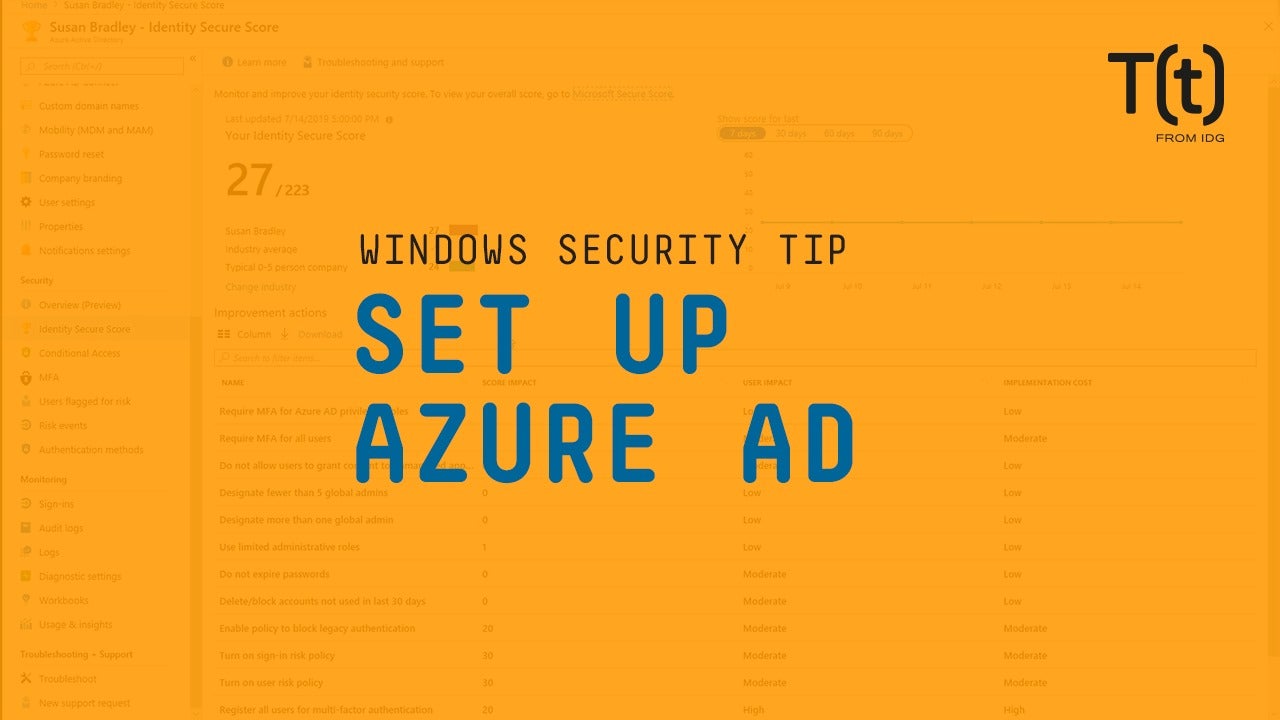
You have several options to set up alerts in Azure Active Directory to help spot risky user behavior.
RSS Reader for Computer Security Articles
You have several options to set up alerts in Azure Active Directory to help spot risky user behavior.

Credit to Author: Brian Barrett| Date: Mon, 22 Jul 2019 22:08:48 +0000
Last week’s US strike of an Iranian drone is the first reported successful use of the Marines’ new energy weapon.
Read More
Credit to Author: Lily Hay Newman| Date: Mon, 22 Jul 2019 19:58:03 +0000
For failing to safeguard Social Security numbers, credit card numbers, and more, Equifax will pay up—but not enough, experts say.
Read More
Credit to Author: Lucas Mearian| Date: Tue, 23 Jul 2019 10:46:00 -0700
Utah County is the latest government entity to pilot a mobile voting application based on blockchain to allow military absentee voters and their family members living overseas to vote in an upcoming municipal primary election.
The county, which has more than a half million residents, is the third in the U.S. to partner with Tusk Philanthropies on a national effort to expand mobile voting. The pilot is a collaboration between the Utah County Elections Division, Tusk Philanthropies, the National Cybersecurity Center and Boston-based voting app developer Voatz.

Credit to Author: Gregg Keizer| Date: Tue, 23 Jul 2019 03:00:00 -0700
Mozilla plans bake its Lockwise password manager into Firefox 70, the upgrade now set to launch Oct. 22.
At the same time, the browser will also be more tightly integrated with Firefox Monitor, which will provide warnings to users when their saved passwords have been revealed by a data hack.
According to Firefox bug reports and project documentation, Lockwise will automatically record username-and-password pairs, generate complex passwords on demand, identify victimized accounts and instruct users to change any passwords that have leaked.

Credit to Author: Peter Wayner| Date: Tue, 23 Jul 2019 03:00:00 -0700
Everyone in the enterprise loves the web browser when it’s delivering news, email, documentation, and sales leads. With the shift to web apps, it’s arguably the most important installed software on any corporate desktop. But the internet is filled with people who aren’t nice — sometimes even dangerous — and the same browser can also bring viruses, rootkits, and worse. Even if the browser sits on a little-used desktop in a dusty corner with no access to sensitive information, an attacker can use the seemingly unimportant machine as a stepping stone.
Keeping your users’ browsers secure is essential. The browser companies work hard to block the attackers by sealing the back doors, side doors, and cracks in between, but that isn’t always enough. Some useful features have dark sides, and enterprises can increase security dramatically by shutting down or tightly limiting access to these options.
(Insider Story)
Read More
Credit to Author: Garrett M. Graff| Date: Mon, 22 Jul 2019 11:00:00 +0000
Here’s what members of Congress should know before they question the former special counsel.
Read More
Credit to Author: Lily Hay Newman| Date: Sun, 21 Jul 2019 11:00:00 +0000
For all the attention on sophisticated nation-state attacks, the malware that’s most likely to hit your phone is much more mundane.
Read More