Security

ComputerWorldIndependent

TV maker Vizio pays $2.2M to settle complaint that it spied on users

Popular smart TV maker Vizio will pay $2.2 million to settle complaints that it violated customers’ privacy by continuously monitoring their viewing habits without their knowledge.

Beginning in February 2014, the Irvine, California-based TV maker tracked what TV shows customers were watching on 11 million TV sets sold in the U.S., the Federal Trade Commission and the Office of the New Jersey Attorney General said in a complaint, released Monday.

Vizio smart TVs captured “second-by-second” information about video displayed, including video from consumer cable services, broadband, set-top boxes, DVDs, over-the-air broadcasts and streaming devices, according to the complaint.

To read this article in full or to leave a comment, please click here

Read More
ComputerWorldIndependent

Researchers’ quantum hacking machine may help protect against quantum computing hacks

There seems to be no form of computing which is safe from hacking, but some, such as the Chinese, have pinned their hopes on quantum computing having uncrackable communications. Yet University of Ottawa researchers have managed to build “the first high-dimensional quantum cloning machine capable of performing quantum hacking to intercept a secure quantum message.”

Last year, China launched the world’s first known quantum communications satellite; the Chinese believed its Quantum Experiments at Space Scale (QUESS) satellite was a step toward “creating an unhackable communications system.” While it may seem like the Canadian researchers have poked holes in the dream of secure quantum communications, the opposite may actually be true.

To read this article in full or to leave a comment, please click here
Read More
ComputerWorldIndependent

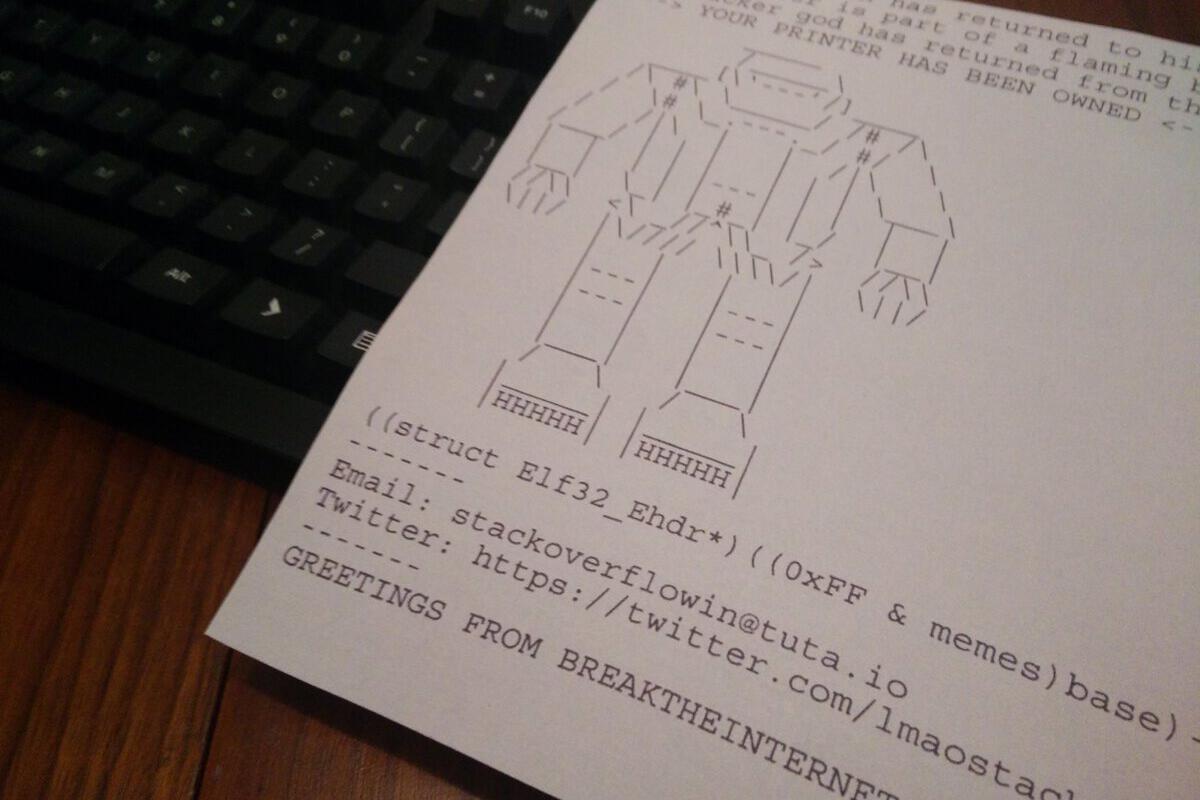
Hacker hijacks thousands of publicly exposed printers to warn owners

Following recent research that showed many printer models are vulnerable to attacks, a hacker decided to prove the point and forced thousands of publicly exposed printers to spew out rogue messages.

The messages included ASCII art depicting robots and warned that the printers had been compromised and they were part of a botnet. The hacker, who uses the online alias Stackoverflowin, later said that the botnet claim was not true and that his efforts served only to raise awareness about the risks of leaving printers exposed to the internet.

Stackoverflowin claims to be a high school student from the U.K. who is interested in security research. He said that for the most part he simply sent print jobs using the Line Printer Daemon (LPD), the Internet Printing Protocol (IPP) and the RAW protocol on communications port 9100 to printers that didn’t require authentication.

To read this article in full or to leave a comment, please click here

Read More
ComputerWorldIndependent

Court orders Google to produce emails stored abroad

A federal court in Pennsylvania has ordered Google to comply with search warrants and produce customer emails stored abroad, in a decision that is in sharp contrast to that of an appeals court in a similar case involving Microsoft.

Magistrate Judge Thomas J. Rueter of the U.S. District Court for the Eastern District of Pennsylvania ruled Friday that the two warrants under the Stored Communications Act (SCA) for emails required by the government in two criminal investigations constituted neither a seizure nor a search of the targets’ data in a foreign country.

Transferring data electronically from a server in a foreign country to Google’s data center in California does not amount to a seizure because “there is no meaningful interference with the account holder’s possessory interest in the user data,” and Google’s algorithm in any case regularly transfers user data from one data center to another without the customer’s knowledge, Rueter wrote.

To read this article in full or to leave a comment, please click here

Read More
ComputerWorldIndependent

Google ordered by U.S. court to produce emails stored abroad

Google has been ordered by a federal court in Pennsylvania to comply with search warrants and produce customer emails stored abroad, in a decision that is in sharp contrast to that of an appeals court in a similar case involving Microsoft.

Magistrate Judge Thomas J. Rueter of the U.S. District Court for the Eastern District of Pennsylvania ruled Friday that the two warrants under the Stored Communications Act (SCA) for emails required by the government in two criminal investigations constituted neither a seizure nor a search of the targets’ data in a foreign country.

Transferring data electronically from a server in a foreign country to Google’s data center in California does not amount to a seizure because “there is no meaningful interference with the account holder’s possessory interest in the user data,” and Google’s algorithm in any case regularly transfers user data from one data center to another without the customer’s knowledge, Judge Rueter wrote.

To read this article in full or to leave a comment, please click here

Read More