Independent

ComputerWorldIndependent

Google ordered by U.S. court to produce emails stored abroad

Google has been ordered by a federal court in Pennsylvania to comply with search warrants and produce customer emails stored abroad, in a decision that is in sharp contrast to that of an appeals court in a similar case involving Microsoft.

Magistrate Judge Thomas J. Rueter of the U.S. District Court for the Eastern District of Pennsylvania ruled Friday that the two warrants under the Stored Communications Act (SCA) for emails required by the government in two criminal investigations constituted neither a seizure nor a search of the targets’ data in a foreign country.

Transferring data electronically from a server in a foreign country to Google’s data center in California does not amount to a seizure because “there is no meaningful interference with the account holder’s possessory interest in the user data,” and Google’s algorithm in any case regularly transfers user data from one data center to another without the customer’s knowledge, Judge Rueter wrote.

To read this article in full or to leave a comment, please click here

Read More
IndependentSecuriteam

Security conferences – Survival guide 2017 Q2


As we promised, the security conferences “Survival guide” for 2017 Q2 is here! We have gathered the following information for you for each conference: Dates Place Link to official conference website Ticket price Lectures Workshops So let’s get started: Security conferences – Survival guide part 2 Infiltrate Dates: 6-7 April 2017 Place: Fontainebleau Miami,Florida US … Continue reading Security conferences – Survival guide 2017 Q2

Read More
ComputerWorldIndependent

5 shocking new threats to your personal data

I’m not paranoid. Tinfoil hats aren’t my scene.

But watch out! In just the past month, the internet and smartphones have come up with five new and surprising ways to steal or expose our personal data.

Of course, these new concerns can now be added to all the old ones. Companies like Google and Facebook still track you and harvest personal data. Hackers still want to steal your data. And the National Security Agency is still out there doing its thing.

And now, these five new trends reveal that your security and privacy could be compromised in ways you probably never imagined.

1. Fingerprints can be stolen from selfies

Researchers at Japan’s National Institute of Informatics (NII) announced recently that your fingerprints could be stolen from photos of your fingers, and the prints could then be re-created and used to bypass biometric security systems.

To read this article in full or to leave a comment, please click here

Read More
ComputerWorldIndependent

Online card fraud up as thieves avoid more secure chip cards for in-store payments

One unfortunate side effect from the use of chip cards for in-store purchases has been an increase in online credit-card fraud.

Hackers have taken the path of least resistance, moving from in-store fraud to e-commerce fraud, according to security experts.

Deterred by the security capabilities of chip cards for in-store payments, thieves have resorted to stealing credit-card numbers and passwords or opening new accounts with false credentials to use in making online payments for purchases, according to recent studies. Botnets also comprise some of the biggest increases in online card fraud.

Read More
IndependentKrebs

How Google Took on Mirai, KrebsOnSecurity


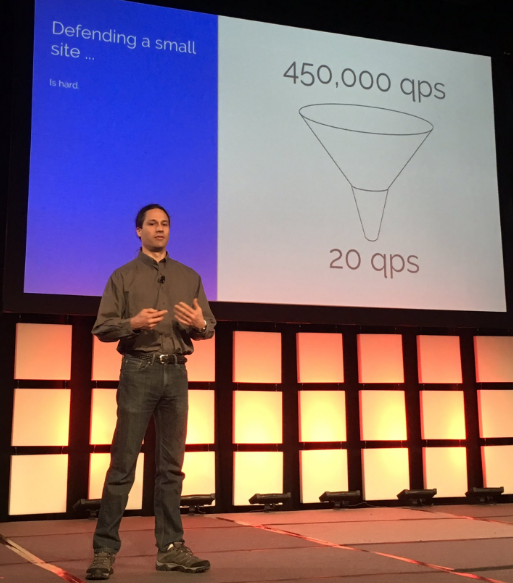
The third week of September 2016 was a dark and stormy one for KrebsOnSecurity. Wave after wave of huge denial-of-service attacks flooded this site, forcing me to pull the plug on it until I could secure protection from further assault. The site resurfaced three days later under the aegis of Google’s Project Shield, an initiative which seeks to protect journalists and news sites from being censored by these crippling digital sieges. Damian Menscher, a Google security engineer with whom I worked very closely on the migration to Project Shield, spoke publicly for the first time this week about the unique challenges involved in protecting a small site like this one from very large, sustained and constantly morphing attacks.

Read More
ComputerWorldIndependent

Microsoft likely to fix Windows SMB denial-of-service flaw on Patch Tuesday

Microsoft will likely wait until February 14 to fix a publicly disclosed vulnerability in the SMB network file sharing protocol that can be exploited to crash Windows computers.

The vulnerability was disclosed Thursday when the security researcher who found it posted a proof-of-concept exploit for it on GitHub. There was concern initially that the flaw might also allow for arbitrary code execution and not just denial-of-service, which would have made it critical.

The CERT Coordination Center (CERT/CC) at Carnegie Mellon University at first mentioned arbitrary code execution as a possibility in an advisory released Thursday. However, the organization has since removed that wording from the document and downgraded the flaw’s severity score from 10 (critical) to 7.8 (high).

To read this article in full or to leave a comment, please click here
Read More
ComputerWorldIndependent

UK defense secretary urges NATO to fend off Russian cyberattacks

The U.K.’s defense secretary is accusing Russia of using cyberattacks to “disable” democratic processes across the West, and he’s demanding that NATO fight back.

“NATO must defend itself as effectively in the cyber sphere as it does in the air, on land, and at sea,” Defense Secretary Michael Fallon said. “So adversaries know there is a price to pay if they use cyber weapons.”

Fallon made the comments in a Thursday speech about the threat of “Russia’s military resurgence.”

He pointed to the Kremlin’s suspected role in influencing last year’s presidential election in the U.S., as part of growing number of alleged cyberattacks that have targeted Western governments.   

To read this article in full or to leave a comment, please click here
Read More
ComputerWorldIndependent

Zero-day Windows file-sharing flaw can crash systems, maybe worse

The implementation of the SMB network file sharing protocol in Windows has a serious vulnerability that could allow hackers to, at the very least, remotely crash systems.

The unpatched vulnerability was publicly disclosed Thursday by an independent security researcher named Laurent Gaffié, who claims that Microsoft has delayed releasing a patch for the flaw for the past three months.

Gaffié, known on Twitter as PythonResponder, published a proof-of-concept exploit for the vulnerability on GitHub, triggering an advisory from the CERT Coordination Center (CERT/CC) at Carnegie Mellon University.

To read this article in full or to leave a comment, please click here

Read More